BMWs are built for people who love driving, but like any performance-focused brand, they reward attentive maintenance. Not every model and year shares the same quirks, yet there are recurring BMW common problems worth knowing. If you’re buying used or trying to keep your current car in top form, this guide will help you spot symptoms early, prioritize repairs, and prevent costly surprises.
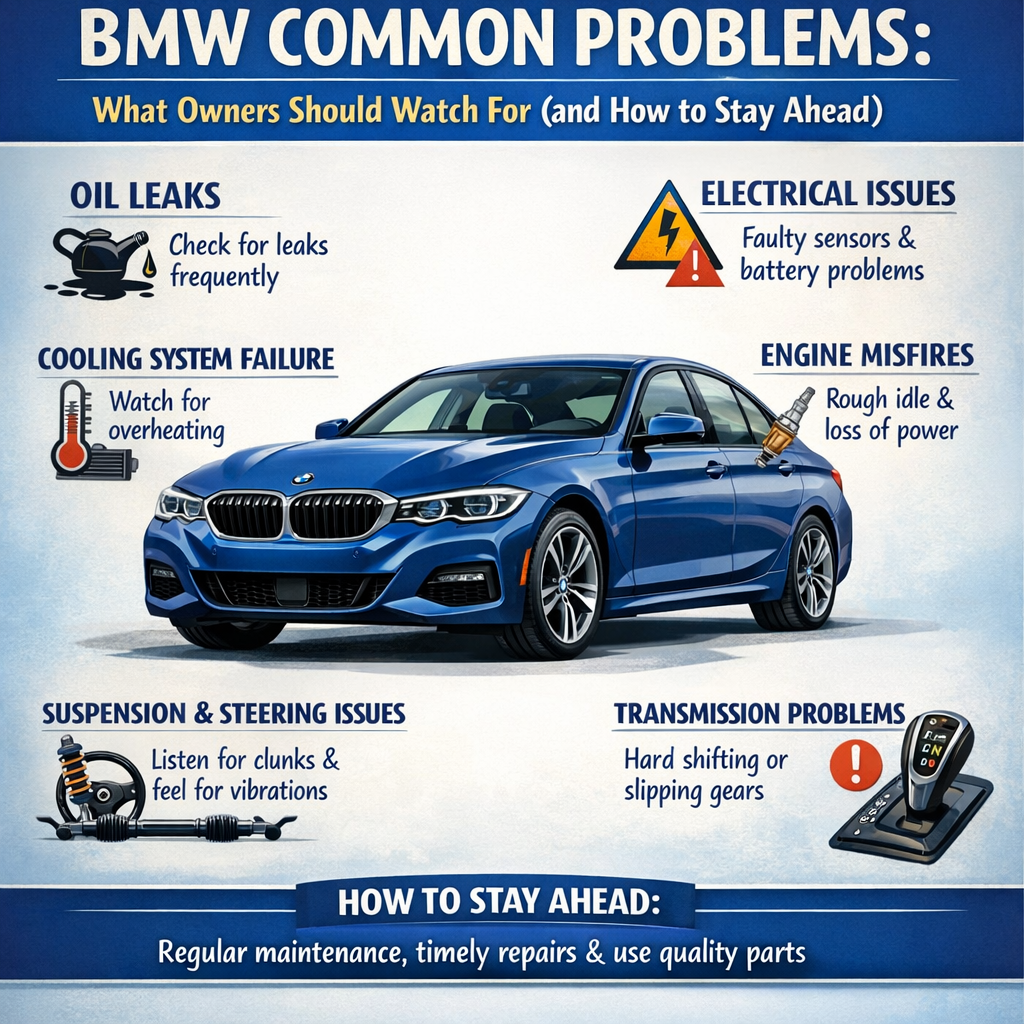
One of the most familiar BMW headaches is the cooling system. Many models use an electric water pump that can fail without much warning, often between 60,000–100,000 miles. Thermostats and expansion tanks are known weak points too. The warning signs aren’t subtle: temperature warnings, erratic heat, or the fan blasting like a jet even when it’s not hot outside. Overheating isn’t something to “watch for later”—it can be catastrophic. Preventive moves include fresh coolant at recommended intervals, paying attention to any minor leaks at the radiator or expansion tank, and replacing the water pump proactively if you’re planning to keep the car long term.
Oil leaks are another common thread. Valve cover gaskets and oil filter housing gaskets harden with age and heat. You might smell burnt oil, see smoke from the engine bay after a drive, or notice oil trails along the block. Some models are also known for oil pan leaks. If your BMW stumbles at idle or leaves spots where it parks, get a proper inspection before the leak compromises sensors, belts, or the alternator. Using quality gaskets, torqueing hardware correctly, and staying on top of oil changes helps reduce recurrence.
On the engine side, several popular BMW engines have known themes. Early turbocharged six-cylinders (like the N54) had high-pressure fuel pump (HPFP) issues and, sometimes, injector problems—long crank, misfires, and limp mode are typical. The N20 4-cylinder (common in 3-Series and X3) had cases of timing chain guide wear leading to chain stretch and rattle, particularly in earlier production years. Diesel fans should note the N47 timing chain wear stereotype as well. If you hear a metallic rattle at cold start or get cam timing-related fault codes, don’t delay diagnosis. A stitch in time with chains and guides saves engines.
BMW’s variable valve timing system (VANOS) earns frequent mentions. Leaky seals or dirty solenoids cause rough idle, hesitation, or a lack of low-end torque. Cleaning or replacing VANOS solenoids is a relatively straightforward fix. Direct-injection models can also build carbon on intake valves, leading to misfires or a sluggish feel. Walnut blasting the intake ports at reasonable intervals brings power and smoothness back.
Drivetrain and suspension need attention too. Front control arm bushings, sway bar links, and rear trailing arm bushings are consumables on many BMWs. If the car tramlines, clunks over bumps, or feels loose under braking, worn bushings are a prime suspect. xDrive transfer cases and differentials need clean fluid; neglect can cause binding or chatter on tight turns. Air suspension (on higher-end and larger models) can leak at the bags or fail at the compressor, dropping a corner overnight or throwing a level control warning. Address air leaks early before the compressor cooks itself trying to keep up.
Electronics are powerful but picky. Weak batteries can trigger a cascade of seemingly unrelated faults—BMWs are sensitive to voltage. If you change a battery, be sure it’s registered to the car so charging behavior matches. Window regulators, iDrive screens/controllers, comfort access sensors, and various modules (parking sensors, FRM footwell modules) are all within the “seen it” category for older cars. Good news: proper diagnostics with a BMW-friendly scan tool usually zeroes in quickly; don’t throw parts without reading codes.
A few quick tells that something needs attention:
- Coolant smell, low coolant warnings, or fan roaring at idle
- Oil smell or smoke near the passenger side of the engine bay
- Rattle at cold start, misfires, or long cranks
- Harsh clunks on bumps or wandering steering feel
- Random electrical gremlins after a battery replacement
Smart habits to prevent repeat visits:
- Shorter oil intervals than the long factory suggestion (e.g., 5k–7.5k miles)
- Fresh coolant, brake fluid, and differential/transfer case fluids on time
- Proactive water pump/thermostat replacement around the “danger zone” mileage
- Walnut blasting for DI engines around 60k–80k miles if idle quality degrades
- Battery registration and a trickle charger if the car sits
Bottom line: BMW common problems cluster around heat, rubber, and electronics. Keep fluids fresh, use quality parts, and find a shop that knows the platform well. The reward is a car that drives like it should—and a lot fewer warning lights.